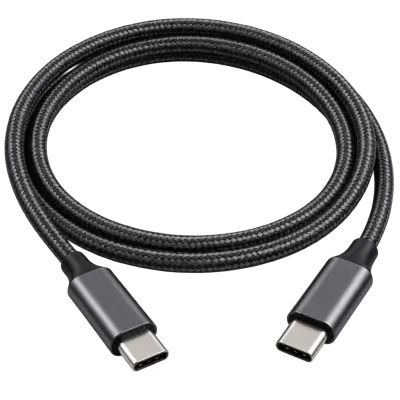
A passive cable is the simplest kind of USB cable: a set of wires connecting the two ends, with no electronic components inside the connectors to boost or manage the signal. Most everyday USB cables, including basic charging cables and shorter data cables, are passive.
The main limitation of a passive cable is length at high speed. As a cable gets longer, signal quality degrades, so a passive cable that works perfectly for USB 2.0 speeds over two metres might not reliably support USB4 at 40 Gbit/s over the same length. This is why longer, high speed cables are often active cables instead.
For charging and everyday data transfer at shorter lengths, a good quality passive cable is entirely sufficient and generally cheaper than an active alternative. See our guide to USB cables for how to choose between them.